





DESIGNING LEARNING FOR COURAGE AND COMPASSION
Through a long-standing approach of industry partnership, Holy Innocents’ High School (HIHS) has fostered a creative, collaborative, and interdisciplinary culture of teaching and learning. The school intentionally designs learning experiences that nurture courageous and compassionate citizens for tomorrow.


Problem Statements
1
How might we design adaptive learning experiences that help students make sense of themselves, others, and the world in an increasingly complex future?
When teaching is framed by siloed content and high achievement in examinations, students can struggle to transfer knowledge across contexts. Creative, adaptive thinking and responsible decision making are critical for applying knowledge to real-life issues. That’s why HIHS has been developing its Mustard Seed Project (MuSP) since 2019, focusing on design thinking and interdisciplinary learning.
The HIHS leadership strongly believes that deep learning happens when subject matter, lived experiences, and values align to shape character. But with the world becoming more complex every year, the school was keen to deepen the impact of the MuSP to ensure its students are ready to face the challenges of the future.
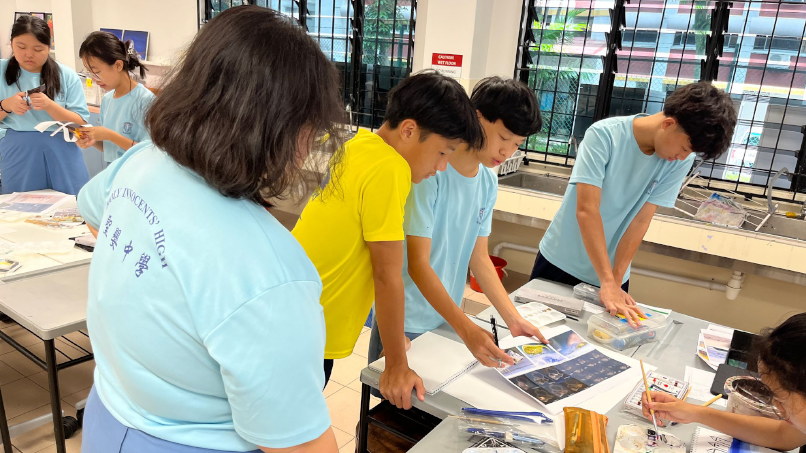
HIHS Secondary 2 students engaged in a MuSP concept-based lesson focused on the change and continuity of Singapore’s Southern Islands. Photo by Holy Innocents’ High School.

HIHS recognised that meaningful change in learning would require new expertise. The school therefore sought a design collaborator who could bring strategic imagination, provoke new thinking, and provide professional guidance. Through the DesignSingapore Council’s Learning by Design initiative, HIHS entered a dynamic partnership with STUCK Design to co-develop new learning and assessment approaches.
A key challenge was shifting student and educator mindsets – balancing near-term learning outcomes with longer-term goals of future-readiness. This meant a shift from subject silos to interdisciplinary thinking, and from content recall to designing for meaning. Educators intentionally redesigned learning experiences that allowed students to see connections, reflect, and take ownership – hallmarks of HIHS’ design-for-learning approach.
Educators’ activities during the partnership included:
• Capability-building workshops to facilitate classroom discourse;
• Building tools for the redesign of lessons;
• Iterative prototyping and collective sense-making;
• Strategic design conversations with students; and
• Developing new student outcomes for interdisciplinary learning.
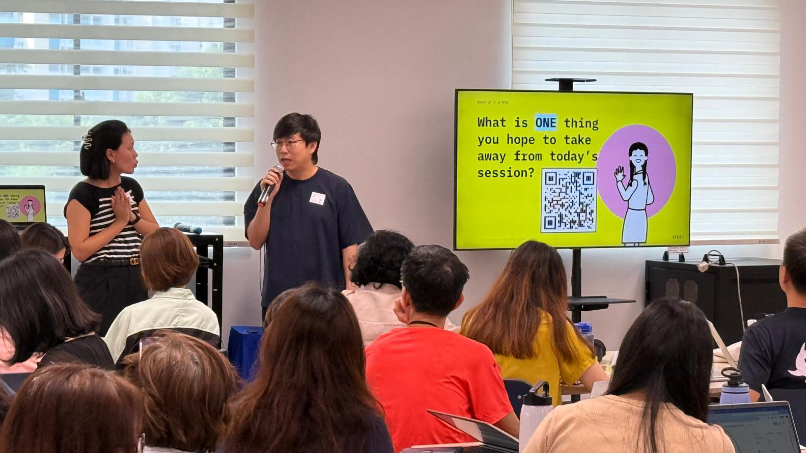
In a workshop, STUCK Design led HIHS educators in rethinking how feedback and failure can shape adaptive learning. Photo by Holy Innocents’ High School.
I appreciated the space for students to display their creativity and problem-solving skills. It pushed us to practise perspective-taking and accept the diversity in students’ response.
Educator
Holy Innocents’ High School
Guided by STUCK Design, HIHS educators shifted away from seeing themselves as instructional planners. They used design thinking to shape learning experiences around critical thinking, self-reflection, and community engagement. Lessons were redesigned around core concepts and learner purposes.
Lessons in the redesigned MuSP are intentionally structured around transferable ideas – a design choice that helps students build cognitive agility and use real-world learning spaces to make values and concepts visible. Assessments now focus on design-driven tasks with projects addressing issues in health, school spaces, or community action. Portfolio reflection structures were integrated to help students track their own growth.
“I learnt the importance of showing how lesson content relates to real-world experiences. When students see these connections, they appreciate what they are learning much more.”
Educator
Holy Innocents’ High School
The collaboration with STUCK Design catalysed a professional culture of experimentation, boundary crossing, and empathy. Teachers now view design not as a discrete skill but as a mindset for shaping learning. Their capacity and confidence grew through iterative prototyping and collective sense-making, giving rise to lessons that foreground conceptual understanding, authentic issues, and student voice.
Students, too, are showing promising signs of growth and readiness for the future, demonstrating numerous 21st-century competencies – for example, increased confidence, a growing sensitivity to different perspectives, a greater sense of purpose and ownership, and an increased awareness of how different subjects connect to real-world issues. True to the ambitions of HIHS, they are exploring their identities as contributors, leaders, and neighbours, not just as learners.
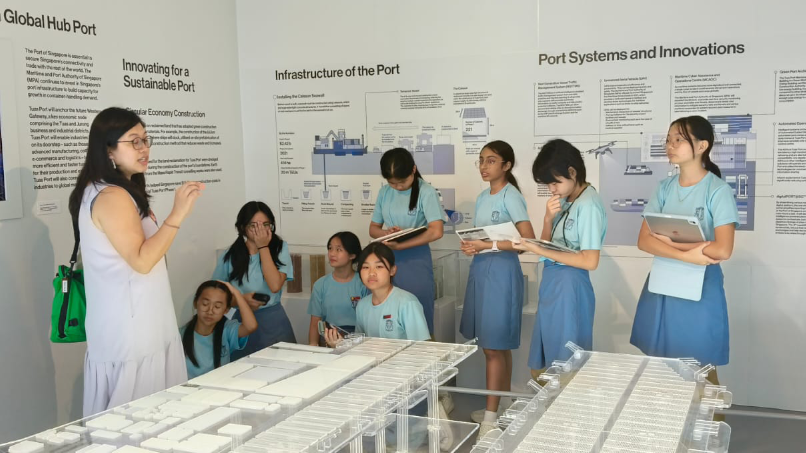
HIHS Secondary 1 students at the Singapore Maritime Gallery, using place-based inquiry to explore Singapore’s maritime identity. Photo by Holy Innocents’ High School.
“The Mustard Seed Project helped me see how combining subjects can make learning more meaningful.”
Secondary 2 Student
Holy Innocents’ High School
HIHS is extending the MuSP journey through initiatives such as the Teens’ Conference 2026, where students will engage with peers across Singapore and ASEAN to discuss youth perspectives on social issues.
Job shadowing opportunities in Shenzhen, China, are also being explored – allowing students to observe how interdisciplinary thinking and civic-mindedness translates into real-world practice.
Certainly, the only place to grow from here is up!
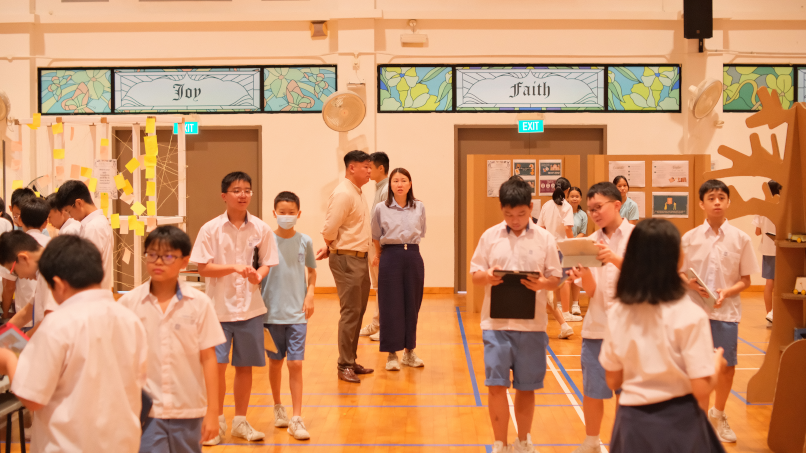
MuSP Canopy is a culminating learning festival where students share, reflect, and connect across levels, making their learning visible and purposeful. Photo by Holy Innocents’ High School.
“It was refreshing to apply what we learnt to a real-world challenge. I enjoyed the group work.”
Secondary 3 Student
Holy Innocents’ High School
Learning environment
• Learning designed to connect knowledge with lived experiences and character formation;
• Learning taken into real-world physical environments;
• A participatory and reflective culture for students and educators; and
Ecosystem support
• Establishing external partnerships to extend learning for students (including with STUCK Design);
• Capability building for educators through co-creation with STUCK Design; and
• Leadership support and distributed ownership.
Pedagogy
• Collaborative learning experiences that foster inclusivity and a spirit of hospitality;
• Moving beyond siloed learning, with student outcomes redefined to enable a more connected, reflective, and future-ready learning experience; and
• Assessment tools progressively strengthened to emphasise real-world connection and reflective practice.


Programme Partner

STUCK Design
Schools
Holy Innocents' High School