








Fail. Learn. Improve. Repeat.
Can failure be a positive experience? At Waterway Primary School (WAPS), failure isn’t the end — it’s part of the process. The school is building a culture where students (and teachers) embrace a growth mindset and see every setback as a chance to get better.
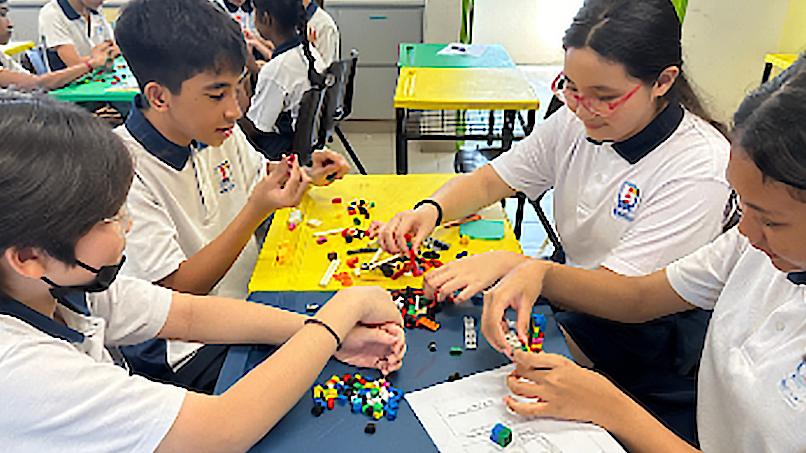
The Neighbourhood Navigators programme was delivered with sponsorship from the DesignSingapore Council’s Learning by Design initiative. The programme partner, Singapore Institute of Technology (SIT). Photo by Waterway Primary School (WAPS).


04 Nov 2025


How do you feel about failure? For many people – be they students, educators, or parents – there’s a stigma around it that’s hard to break. But this attitude can overlook valuable opportunities for growth and adaptation.
One thing’s for sure: change will be the only constant in the future. Learning today’s facts on the basis of right or wrong answers won’t equip students with the adaptability and future-ready mindsets they’ll need to thrive as change accelerates.
Recognising this, WAPS has put in place a whole-school programme that drives innovative thinking and builds resilience. Delivered progressively from Primary 1 through to Primary 6, the Makers@WAPS initiative was designed to equip students with the mindsets of changemakers and tinkerers who are ready to respond to change – and to iterate as they do.

The development of 21st-century competencies such as critical, adaptive, and inventive thinking is core to the ambition and curriculum of Makers@WAPS. So naturally, design thinking skills are central components of the programme. But as the name suggests, so too are making skills. Educators are encouraged to meaningfully integrate design thinking and makerspace resources into their daily classroom practices.
The goal is to teach students that learning is a process, and iterating on ideas is key to success. WAPS leadership has realised that exploration, prototyping, tinkering, and improving on something shifts failure from a negative to a positive experience. Far from a source of shame tied to wrong answers, failure becomes a wellspring of empowerment – a valuable and essential part of an iterative learning journey. So, what does that journey look like?
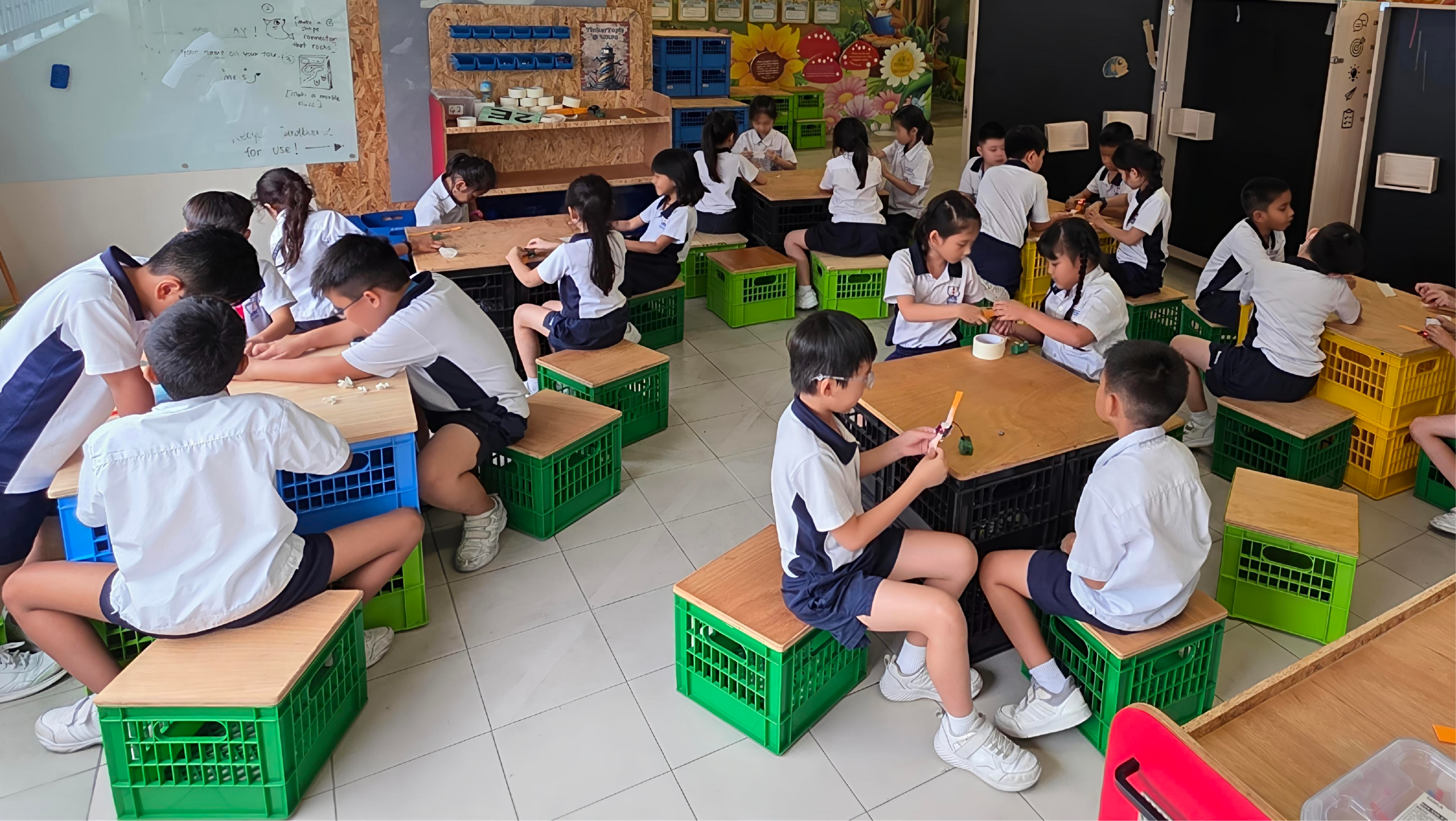
WAPS has created makerspaces known as “Tinkertopia” and “ImagiNation Hub,” where students can explore and tinker. Photo by Waterway Primary School.
In Primary 1 and 2, the focus is on preliminary exposure to age-appropriate facets of making, with basic crafting and digital making activities integrated into classes.
In Primary 3 and 4, design thinking and prototyping are introduced through activities such as coding, 3D pen fabrication, and cardboard sculpting. At this point, a real-world thematic approach is embedded to enhance student engagement and relevance, with the focus being on peer relationships.
By Primary 5 and 6, students are exposed to signature hackathons tied to the themes of eco-sustainability (Primary 5) and benefitting the community (Primary 6). Students are also exposed to the use of AI and 3D printing. Students taking elective enrichment can choose to take up the Learning by Design “Neighbourhood Navigators” programme.
Ultimately, by the conclusion of Primary 6, the vision is that students will be able to identify as being a changemaker who has the resilience to positively respond and contribute to an ever-evolving society.
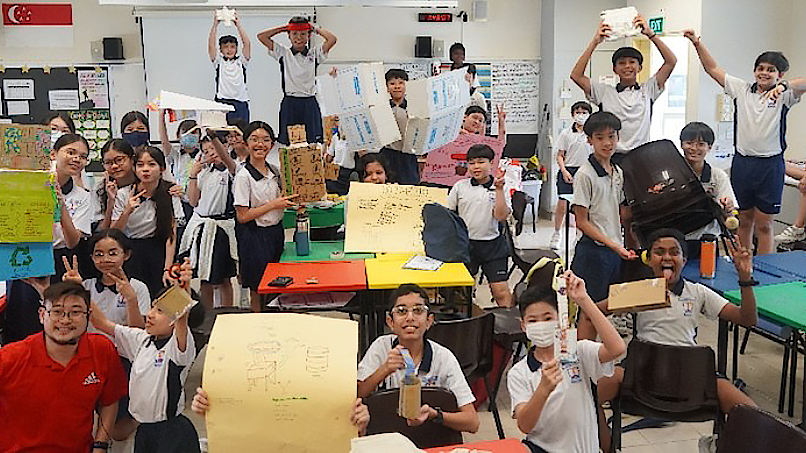
WAPS runs signature hackathons for students in Primary 4-6. While students were initially apprehensive, students have grown to enjoy and value these experiences. Photo by Waterway Primary School.
Embracing failure required a significant mindset shift for students and parents, as many had internalised the belief that failure is negative and to be avoided. The shift has been challenging for educators, too, as those unfamiliar with facilitating design thinking have gone through the process of learning the ropes. But tenacity has prevailed.
Says Mr. Jason Yew, the Subject Head of the I&E committee at WAPS, “Along the way, we have often asked ourselves if our plans were too ambitious or age appropriate. Time and again, our students have risen to the challenge and humbled us with their creativity, resilience, and insight.”
Students are now much more aware of the value of design thinking. As revealed by surveys that were conducted after the Primary 5 and 6 hackathons, they are also more open to applying design thinking as a problem-solving tool when faced with challenges.
“I have learnt to look at problems from different perspectives,” comments Primary 6 student Elijah about his experience of the Learning by Design extracurricular component. He continues, “If I were to face a problem right now, I would definitely take some time to look at it differently, to try to further understand the problem, and try to solve it in the best ways possible.”
There has also been stronger buy-in from educators, who are increasingly acknowledging the importance of equipping students with design thinking and making skills as essential future-ready competencies. To ensure a fully rounded effort, WAPS openly sought the partnership of parents in removing the stigma of failure and supporting the school-wide initiatives to foster a growth mindset.
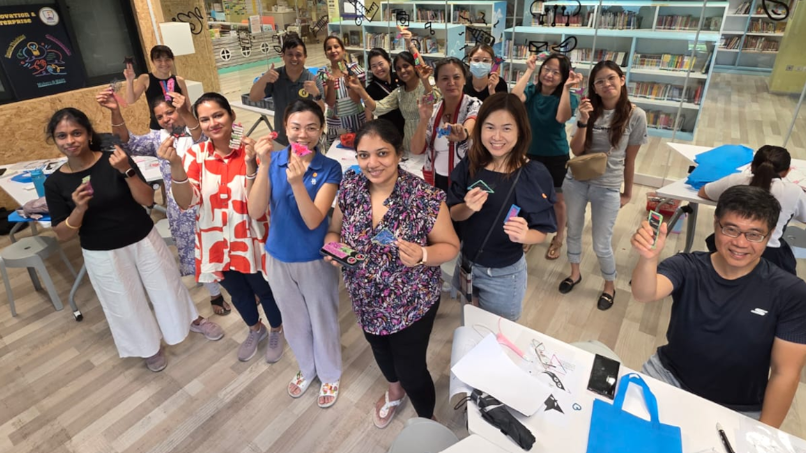
The school’s outreach to parents strengthens its home-school partnership. Photo by Waterway Primary School.
That’s just one example of the good organisational practices that have fueled change at WAPS. Reframing failure as a valuable part of the learning process remains an ongoing effort that is continually reviewed and bolstered by industry and community partnerships as well as parent engagement.
School

Waterway Primary School